CRM
Convert opportunities and accepted quotations into customer orders.
TEZ ERP connects every order with stock, purchasing, production, warehouse, dispatch and finance.
Capture, fulfil, dispatch and track every order through one connected process.
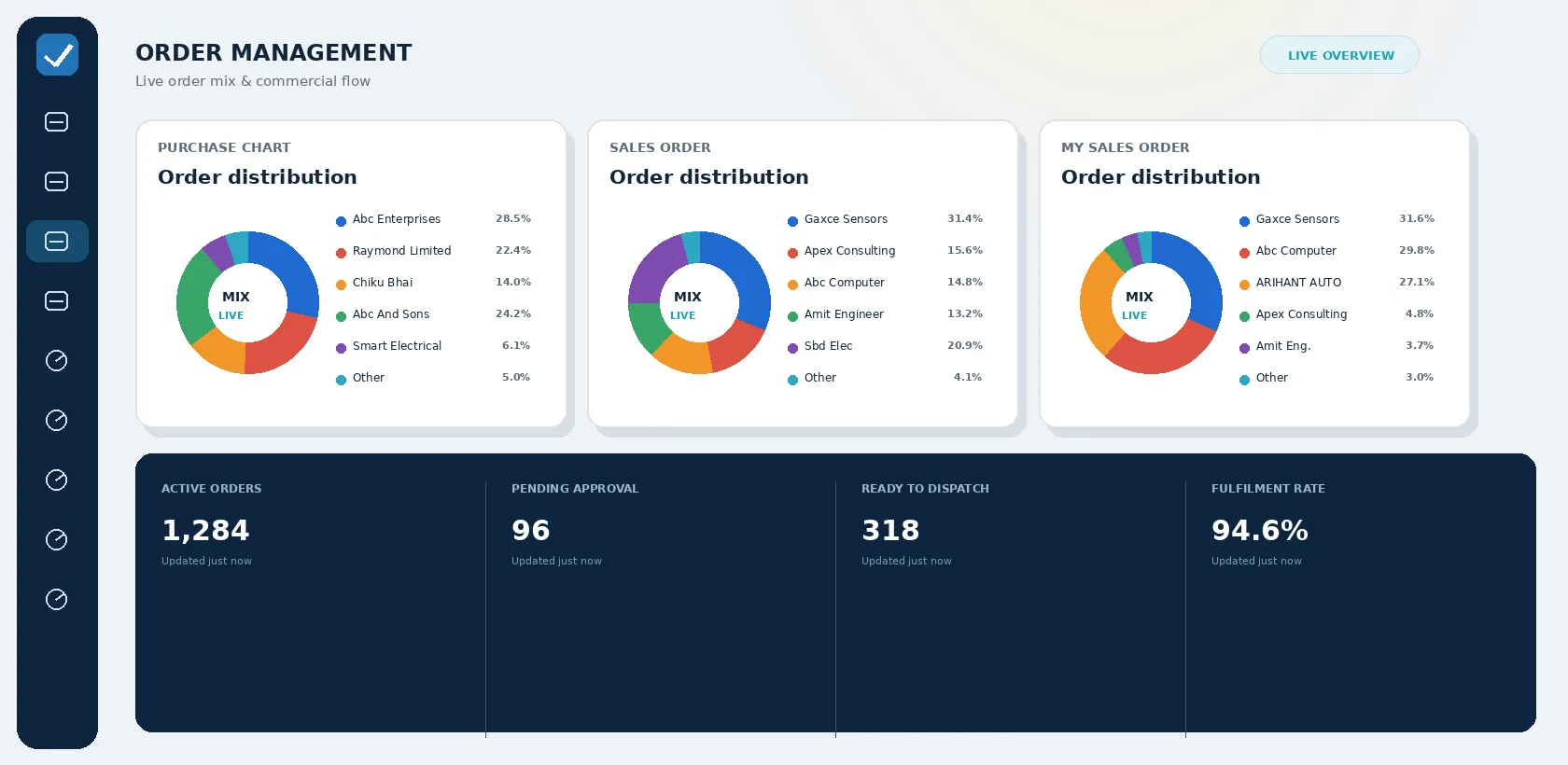
A serious Order Management system must answer the hard operational and commercial questions behind every commitment:
TEZ keeps these answers connected to the original order.
No matter where the order begins, it enters one controlled process.
Customer requirements may originate from different teams, platforms and commercial channels. TEZ can bring applicable orders into a common order-management process from:
Convert opportunities and accepted quotations into customer orders.
Allow authorised agents to submit and track orders relevant to them.
Allow customers to place requirements and access applicable order information.
Receive distributor, dealer, institutional and business orders.
Connect applicable online consumer orders with billing, stock and fulfilment.
Accept orders from connected websites, applications and other authorised systems.
Convert project or quantity requirements into commercial and fulfilment transactions.
Enter an individual order directly or upload larger order datasets through Excel.
One workflow can branch according to how the order must be fulfilled, while the original requirement remains traceable across sales, procurement, and manufacturing.
One workflow can branch according to how the order must be fulfilled, while the original requirement remains traceable.
Create quotations directly or from applicable CRM opportunities with full commercial and compliance context.
Select an item by its name, alias or UPC and automatically bring its description, rate, unit, HSN and tax information into the quotation.
Quotation list summaries provide leadership and sales executives live visibility across open commercial offers.
Filter, search and sort quotations by company, branch, department, region, customer group, agent, number, date, amount, item, quantity or status.
The selected information is carried forward instead of being entered again.
A Sales Order maintains the complete commercial, inventory and delivery context in one verified record.
Customer, address, tax, agent and due-date information can be populated from the Customer Master. Item descriptions, rates and taxes populate from the Item Master or the last transaction.
TEZ reduces repetitive entry through smart defaults, auto-lookups, and bulk utilities.
Advanced functionality remains available without making routine entry unnecessarily complicated.
TEZ supports configuration at multiple commercial and operational levels.
Add order-level information such as project, delivery instruction, tender reference or commercial classification.
Add line-level information such as specification, colour, size, drawing number or customer part code.
Add charges such as packing, forwarding, delivery, insurance or handling and post them to relevant ledgers.
Enable batch or serial-number information where the product requires strict unit traceability.
Create different Sales Order print templates using configurable HTML formats.
TEZ clearly distinguishes approved and unapproved Sales Orders across the organization.
This is stronger than simply placing an approval label on the order. Approval determines whether the order can move forward.
Approval conditions can be designed around multi-dimensional commercial and operational thresholds:
Routine orders continue quickly. Commercial exceptions are held for appropriate review.
An item may physically exist in the godown but already be committed against another approved customer order.
Configurable negative-stock controls consider pending orders so users do not repeatedly promise the same quantity. Know the stock. Know commitments. Know what remains available.
TEZ Sales Order Summary brings together live execution readiness across the order book.
Orders that can be fulfilled completely are highlighted distinctly. Orders that can be fulfilled only partially are separately identified. Sort by order number, order date, due date or order value.
When an invoice is generated, the availability position refreshes immediately. A live fulfilment decision—not a static order register.
From the Sales Order, authorised users create downstream documents without re-keying data:
Create a back-to-back Purchase Order for items required specifically for the Sales Order.
Issue a commercial document for advance collection before final billing.
Send material where site installation, demonstration or billing takes place later.
Convert pending Sales Order quantities into a compliant tax invoice.
Create manufacturing instructions for products that must be produced.
Generate warehouse instructions for precise material selection.
The new document is prefilled with relevant information from the Sales Order.
When a partially processed Sales Order is converted, TEZ brings pending items and quantities into the next document.
This protects the user from accidentally processing the full original quantity again. The Sales Order closes only to the extent processed or manually authorised.
Separate commercial approval from fulfilment progression.
The order has been approved but has not yet been processed downstream.
Only part of the order has been fulfilled or invoiced; balances remain open.
The complete ordered quantity has been dispatched and invoiced.
The remaining quantity is no longer required and has been closed by an authorised user.
A partially fulfilled order does not disappear merely because one invoice was raised.
The Adjustment view shows every document linked to the Sales Order:
This explains exactly how an order reached its current status.
Create a Proforma Invoice from the Sales Order carrying forward customer, addresses, items, quantities, rates, taxes, freight, terms and attachments.
The list clearly distinguishes billed, unbilled and total commercial value.
TEZ supports Delivery Challans for businesses that supply, install, demonstrate, process or move goods before raising the final tax invoice.
One or more Delivery Challans can be consolidated into a single Sales Invoice.
A Delivery Challan moves goods physically to the customer without transferring ownership through an invoice.
TEZ retains this crucial accounting distinction: goods remain part of the organisation’s closing stock while identified as physically lying at the customer site.
Delivery Challans are considered during negative-stock checks while billing, according to configuration.
Gives the business both views: Stock as an accounting asset • Stock by its physical location.
Ensure delivered goods do not slip through without proper financial invoicing.
The system keeps delivered-but-unbilled material visible until financial closure.
Sales Orders, Proforma Invoices and Delivery Challans flow into Sales Invoices without repetitive data entry. Counter-based POS billing is also fully supported.
Commercial, inventory, taxation and accounting records originate from the same single transaction.
Customer GSTIN, branch state, place of supply, HSN, tax rate and taxable value flow seamlessly into the commercial transaction.
The system determines interstate or intrastate tax treatment automatically from transaction parameters.
Once the sales invoice is prepared, it immediately appears in Dispatch Management for logistics execution.
The transaction moves from open to dispatched when info is saved. Delivery completion is recorded upon customer receipt.
Accelerate dispatch operations across multiple vehicles, transporters and consignees.
Communicate order updates through Email, SMS, WhatsApp and Customer Portal.
The customer remains informed without requiring a manual phone call for every dispatch.
Generate a Pick List directly from applicable Sales Orders or Proforma Invoices.
The warehouse sees its operational requirement clearly without needing to interpret complex commercial pricing documents.
TEZ Packing Management maintains granular carton-level packing records with batch and serial integrity.
Filter entries by Order, Item, Carton, Company, Branch, Department or Date. Generate barcodes against packed material.
Batch information preserves end-to-end traceability between stock, packing, and dispatch.
Record vehicle and material movement at the physical factory or warehouse gate.
Maintain arrival and exit timestamps for transport vehicles entering the premises.
Create inward records against Purchase Orders and Sales Returns; seamlessly convert into GRN.
Create outward gate passes against pending Sales Invoices, Delivery Challans, and Debit Notes.
Security and stores teams select the originating ERP transaction rather than keeping disconnected logbooks.
Departments, branches, stores and production teams raise Indents for operational requirements.
Maintain requesting company/branch/department, destination branch/department, item, quantity, date, purpose and remarks.
An Indent records demand accurately without prematurely changing physical stock.
From an approved Indent, authorised users immediately trigger appropriate downstream transactions:
Fulfil the requirement from stock already available in another branch or godown.
Procure the required material from an approved vendor.
Record direct procurement where material and invoice arrive together.
Bill internally requested or supplied material where commercial recovery applies.
The Indent retains pending, partial and completed quantities and shows all transactions created against it.
TEZ enforces dual-handshake stock movement between Companies, Branches, Godowns, Stores and Departments.
The issuing location records the stock transfer. The destination records Stock Acceptance when material is physically received. During transit, material remains visible as stock in transit.
Each stage remains separately identifiable and accountable.
Goods Release acts as an operational gate before material moves into transfer, production, job work or customer fulfilment.
Provides an essential checkpoint of authorisation between the administrative requirement and physical warehouse release.
Prevents premature dispatch or unapproved factory floor material consumption.
Purchase requirements originate directly from business demand:
TEZ prefills Purchase Orders from the originating requirement, eliminating duplicate entry and preserving traceability.
Maintain complete vendor procurement agreements and commercial terms:
Purchase Orders can be printed, converted to PDF, emailed, shared through WhatsApp, uploaded via Excel, and tracked by status.
Enforce governance before procurement commitments reach vendors.
Control whether purchased quantities may exceed original requested indent quantities.
Only approved procurement results in vendor communication, receipt or financial liability.
Enable direct collaboration with external suppliers without compromising internal security:
Vendors participate directly in the supply workflow without access to internal ERP records.
The PO Summary brings together complete net requirement variables:
Click the required quantity to begin creating a Purchase Order prefilled with details from the last purchase.
Know what is required. Know what is already coming. Buy only the balance.
Maintain live visibility into goods travelling between vendor, branch, warehouse or processing unit.
Pending POs flow into Transit Management. Upon arrival, related GRNs or Purchase Invoices are generated with complete audit trails.
GRN captures raw physical arrival across various inward sources:
Capture vendor, PO, challan, arrival date, ordered vs received quantity, batch, serial, expiry, transporter, vehicle, LR, boxes and freight.
The GRN remains distinct from accepted usable stock and financial bills.
TEZ strictly segregates inward stages to safeguard financial and inventory integrity.
Vehicle and goods reached the premises and passed gate entry.
Quantity passed QC inspection and is released into usable inventory.
Vendor invoice verified against PO and GRN, posting financially to AP.
Identifies: Material awaiting QC • Material received not accepted • Material accepted not billed • Billed with qty variance • Rejected awaiting Debit Note.
Record Quality Control readings directly against the GRN before stock release.
Ensures the next document cannot be created merely because material physically landed at the loading bay. QC reports can be printed for compliance.
Control whether received quantity may exceed Purchase Order quantity.
Prevents unplanned excess inventory accumulation and incorrect vendor over-billing.
From the GRN, authorised users trigger immediate downstream operations:
Related documents clearly document how the GRN was processed.
Generate a Put List to direct inward material systematically from unloading to storage racks.
Receiving and storage become connected, trackable steps instead of disconnected manual notes.
Deploy barcodes to accelerate throughput and eliminate human error in high-volume operations.
Reduces repetitive typing and wrong item dispatches in fast-paced warehouses.
Create Purchase Bills from Purchase Orders or GRNs carrying forward pending quantities automatically.
The Purchase Bill posts the vendor accounts payable liability and updates inventory valuation and tax ledgers.
Maintain payment remarks and route disbursements through structured approval matrices before release.
Only authorised disbursements proceed to the final banking stage.
Approved vendor payouts flow seamlessly into banking payment rails and automated API integrations.
Procurement, accounts payable and corporate banking share one unified liability and payment trail.
TEZ Bill of Entry functionality manages foreign procurement, customs compliance, and complex landing costing.
Capture every import duty and statutory surcharge to calculate actual inventory cost:
Cost decisions reflect real landed cost—not merely the foreign supplier’s invoice price.
Generate adjustments with full audit links to the originating sales or purchase voucher:
Debit and Credit Notes remain irrevocably linked to the transaction responsible for the commercial discrepancy.
Customer invoices connect directly with multiple collection methods:
The customer order journey stays visible all the way through billing, collection, and bank deposit.
Track incoming and outgoing post-dated cheques to maintain accurate cash-flow forecasts.
Empowers collection planning, vendor payment scheduling, liquidity visibility, and automatic receipt generation on clearance.
Customer receipts and vendor disbursements reconcile automatically against live bank activity.
The order-to-cash and procure-to-pay lifecycles conclude in fully reconciled financial ledgers.
A Sales Order for a manufactured item contributes directly to production planning without manual handoffs.
Production remains linked to actual customer demand instead of being managed on separate spreadsheets.
Production scheduling dynamically evaluates shop-floor realities against customer commitments:
Helps production planners distinguish immediate committed customer demand from general stock-building runs.
A Work Order issues authorised execution instructions to factory teams.
From the Work Order, teams generate Material Indents, Stock Transfers, and Production Vouchers until the order is complete.
Where a product passes through sequential operations, TEZ maintains stage-wise integrity:
Completion of an initial stage does not incorrectly assume completion of the entire product route.
TEZ Job Work maintains tight governance over external sub-contractors:
Track whether Job Work is pending, billed, closed or completed with complete regulatory compliance.
Production Vouchers accurately capture raw-material consumption and finished output yields.
Finished-Goods Quality Control verifies output meets all required technical specifications before releasing it for customer fulfilment.
Accepted manufactured stock flows back into the Sales Order Summary as executable inventory.
Reconcile physical warehouse stock counts against ERP ledger balances.
Controlled adjustments correct approved discrepancies while retaining complete reason trails. Updates immediately reflect in fulfilment decisions.
Identify slow-moving stock, overdue commitments, and bottlenecked documentation:
Ageing reports pinpoint documents and stock that have remained unacted upon beyond acceptable business thresholds.
Act while the order, delivery, or collection can still be protected.
Orders awaiting approval • Overdue orders • Stock shortages • Orders needing procurement • Orders needing production • Margin exceptions.
Unconverted Indents • Unapproved POs • POs overdue • Delayed transit • Excess/short receipt • GRNs awaiting QC • Unbilled GRNs.
Ready not picked • Picked not packed • Packed not dispatched • Challans unbilled • Invoices undispatched • Dispatches unconfirmed.
Overdue invoices • Unadjusted receipts • PDCs approaching due date • Payments awaiting approval • Unreconciled bank entries.
Comprehensive operational, commercial, and executive reporting:
End-to-end procurement and vendor performance metrics:
Dedicated logistical and warehouse execution analysis:
Role-specific consoles displaying live operational KPIs:
New orders, pending quotes, orders due today, credit exceptions, conversion rates, executive value.
Required purchase quantity, unconverted indents, pending PO approvals, vendor delays, transit status.
Ready to pick, pending packing, put-away queues, pending Work Orders, process completion, FG QC.
Unbilled challans, unbilled GRNs, receivables, PDCs, total order book, executable value, order cycle time.
Every tile opens directly into the underlying transactions behind the KPI number.
Tailor filters, columns, sorting, and layouts to match your workflow.
Add or remove columns, rename headers, pin preferred layouts, save frequent views, export to Excel, and schedule automated email alerts with strict role-based access.
Attach supporting evidence directly to ERP vouchers to eliminate paper chasing:
Users reviewing the order access evidence directly without searching emails or paper binders.
Configure automated triggers across your supply chain:
Delivered automatically via Email, SMS, WhatsApp, Chatbot, Transaction Bot, Portals, and REST APIs.
Start with any order and traverse the connected operational chain:
CRM → Quotation & SO → Stock / PO / Production → Pick, Pack, Put → GST & E-Way → Challan, Gate, Dispatch → Invoice, Receipt, Bank Recon → Profitability.
A summary is useful. A traceable summary is significantly more powerful.
Instant clarity across 28 fundamental operational questions:
TEZ keeps every single answer inside the connected order record.
TEZ brings together every stage of your order lifecycle into one cohesive, modern environment:
The simplest route from customer demand to delivery and money.
TEZ ERP helps your organisation know: What was ordered. What can be supplied. What must be purchased. What must be produced. What is awaiting approval. What has been received. What has passed QC. What has been picked and packed. What has been billed. What has been dispatched. What has been delivered. And what remains pending.
The simplest way to manage the complete journey from demand to delivery and money.